Hiking in the Volcanoes National Park

Responsible Travel

Hiking in the Volcanoes National Park


The Volcanoes National Park comprises of a range of six extinct and three active volcanoes form the Virunga Massif, spanning altitudes from 2,400m to 4,507m. The Volcanoes National Park protects the Rwandan sector, with the other slopes falling within Uganda and the Democratic Republic of Congo. The Volcanoes are a nature lovers dream, possessing incredible natural beauty; including lush forests and different vegetation zones, beautiful crater lakes, breathtaking scenery and unique mountain life. The park is best known for tracking gorillas but there is plenty more to see and do and hiking is one of the astounding activities to be done.


MOUNT KARISIMBI 

Starting point: Bisoke Parking 

Duration: 2 days 

Length: 12 km (x2) 

Level: Challenging

‘Karisimbi’, which translates as white shell, refers to the frequently white-capped cloud cover at the summit. At 4,507m it is a strenuous yet rewarding hike, which takes two days, camping along the way. As this is the territory of gorillas, other primates and many bird species, hikers could be blessed with a chance of meeting them along the way

Visitor Category                                

 Adult

                                              Student / Child
Foreign   $ 400
Foreign Resident in Rwanda   $250 $180
Rwandan Citizen   RFW 30000 RFW 15000
East African Citizen   $200 $180
East African Foreign Resident   $300 $180


MOUNT MUHABURA 

Starting point: Nyagahinga 

Duration: 8 hours (x2) 

Length: 9 km (x2) 

Level: Challenging

Mount Muhabura is the second highest of the Rwandan Virunga Volcanoes, bordering Rwanda and Uganda, and the steepest of all. The Mount Muhabura hike is the most demanding hike up to 4,127m and especially since hikers are required to complete the hike in a day. For those who make it all the way up to the top, breathtaking scenery will reward their challenging climb.

Visitor Category                                

 Adult

                                              Student / Child
Foreign   $ 100
Foreign Resident in Rwanda   $75 $45
Rwandan Citizen   RFW 5000 RFW 3000
East African Citizen   $60 $45
East African Foreign Resident   $80 $45


MOUNT BISOKE 

Starting point: Bisoke Parking 

Duration: 5 hours (x2)

 Length: 6.5 km (x2)

Level: Challenging

 For those keen to summit Mount Bisoke, a crater lake awaits at the top, which lies at 3,700m. This trail takes anything from five hours to a whole day.


Visitor Category                                

 Adult

                                              Student / Child
Foreign   $ 75
Foreign Resident in Rwanda $65 $45
Rwandan Citizen RFW 4000 RFW 2000
East African Citizen $55 $45
East African Foreign Resident $65 $45


MOUNT GAHINGA 

Starting point: Gatabi Parking 

Duration: 5 hours (x2) 

Length: 5 km (x2) 

Level: Challenging

On top of the famous mountain gorillas, Gahinga is also home to several other species of animals and birds that form part of the Mount Gahinga ecosystem. The equally endangered golden monkeys are an example of that ecosystem

Visitor Category                                

 Adult

                                              Student / Child
Foreign   $ 75
Foreign Resident in Rwanda $65 $45
Rwandan Citizen RFW 4000 RFW 2000
East African Citizen $55 $45
East African Foreign Resident $65 $45


KARISOKE RESEARCH CENTER (DIAN FOSSEY TOMB) 

Starting point: Bisoke Parking

 Duration: 3 hours 

Level: Challenging

In the saddle area between Mount Karisimbi and Mount Bisoke is the Karisoke Research Centre, founded by Dian Fossey in 1967, as well as the site of her grave. The walk up takes about an hour to an hour and a half, starting with a drive from the park headquarters 30 minutes away

Visitor Category                                

 Adult

                                              Student / Child
Foreign   $ 75
Foreign Resident in Rwanda $60 $45
Rwandan Citizen RFW 4000 RFW 2000
East African Citizen $55 $45
East African Foreign Resident $65 $45


Dian Fossey is portrayed in Gorillas in the Mist, a 1988 American drama film directed by Michael Apted and starring Sigourney Weaver. Her anti-poaching patrols led to the arrest of many poachers who were sentenced to jail and some are still serving their sentences. Dian was murdered in 1985 in her tent at her research institute by unknown murders where she was found lying in a pool of blood in the early morning of December 27, 1985. Fossey is buried at Karisoke, in a site that she herself had constructed for her deceased gorilla friends. She was buried in the gorilla graveyard next to Digit, and near many gorillas killed by poachers. Memorial services were also held in New York, Washington, and California.

 Best time for volcano hiking 

Rwanda falls very close to the equator. So while its weather patterns vary, there aren’t very extreme variations. Rainy season between March and May and late in September to November, this is the time to avoid hiking, especially as there are frequent rain,  storms and lightning which render the trails very muddy and the hike is difficult.  The dry season is usually from June to around September and later in December to around February. The dry season is the best time because the trails are dry and climbing is therefore easier. 

What to prepare for the hike: 

Long trousers and long sleeve (to minimize the impact on wildlife, it is recommended to wear shades of green or brown).

 Hiking waterproof boats  

Carry garden gloves, 

A rain jacket, 

Gaiters

Sunscreen

A camera


For Responsible hike: Do not leave a trace, Stay on the trail and respect wildlife.
Congo Nile Trail Hiking

Responsible Travel

Congo Nile Trail Hiking

“Goodmorning!”

I hear children shout in our direction. We are walking through a plantain field and the shade offered by the large crop helps us regain strength after hiking one of Rwanda’s thousand hills. Suddenly I can see the children in the distance. They are running towards us, waving and shouting.

“Goodmorning!” “Goodmorning!”

We respond by saying “Muraho!” (Hello in kinyarwanda).  Upon seeing their smiles we immediately forget our tired legs and feel motivated to continue our hike along the Congo Nile Trail!

–

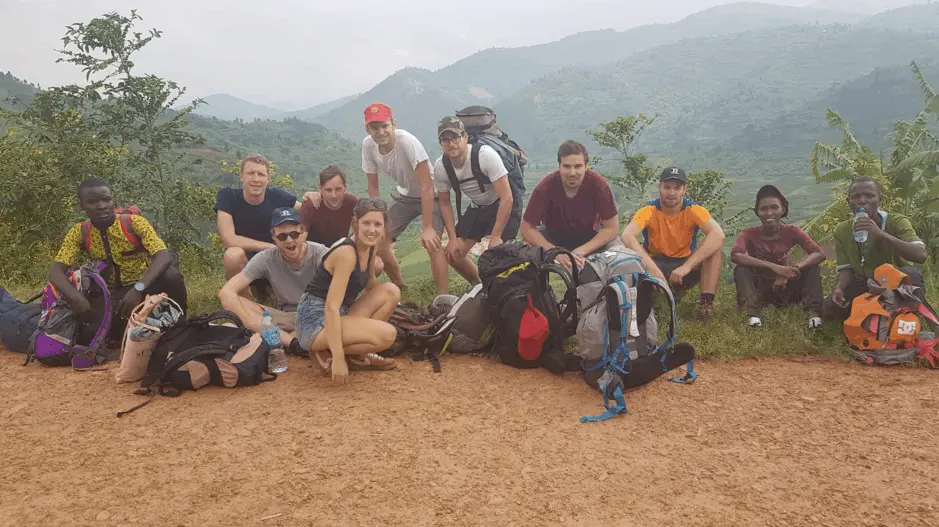
In January 2019 I hiked a part of the Congo Nile Trail in Rwanda with a group of friends. The trail follows the eastern shore of the spectacular Kivu Lake and offers more than just a great hiking experience. In this short blog post I will list some reasons why this is an absolute must when visiting Rwanda.

The Hike

There is not just one way of hiking the Congo Nile Trail. Many small trails connect the different villages and depending on your guide, you might take a different route. The main trail follows a dirt road that circles though the rolling hills. On this road, the trail is marked with directions. This road allows doing the trail with a mountain bike as well. When hiking with a guide you will spent most of your time following smaller trails that cross trough fields, hills and rivers. We hiked from Kibuye to Gisenyi in four days. The hike is demanding, with large distances (one day of 30km) and quite some elevation. You could make the hike easier however by spreading it over 5-6 days or shortening some days by taking a boat or moto taxi. The trail is in good condition and safe to hike, although I would recommend a guide if you want to take the smaller adventurous paths.

The Way of Living

In Rwanda, you are never alone. Along the trail, you will see many Rwandese living and working in the fields and villages. In this rural setting, you see a completely different lifestyle than in Kigali. At first, people might appear shy and reluctant; however, this changes when they get to talk about their craft or nature. Thanks to our guide, we were able to watch a beekeeper perform his craft in a traditional way, using hollowed out tree trunks. Most communities are highly self-sustaining, a way of living from which we can all learn. Nevertheless, there is also poverty, but the living standards seem to be improving.

The Guest Houses

Several guest houses are located along the trail. All places were perfect to relax after a tough hiking day, and they all had decent beds with mosquito nets and a nice dinner & breakfast. I especially remember the guest house in Bumba. We were welcomed with great hospitality and a truly astonishing view (see below). Some places might not have a hot water shower, but you can always ask for a basin filled with hot water. There is also the possibility to choose hotels that offer more luxury, although I found the guesthouses very charming.

The Experience

As mentioned before, the Congo Nile Trail is more than just a hike. You get to experience Rwanda in a very non-touristic way, meet people, try local food and discover a different culture. It was the highlight of my trip to East Africa, and I hope to hike it again in the future.


By Pieter Nachtergaele, 11/12/2021

Michael’s island on the Twin Lakes

Michael’s island on the Twin Lakes

Lake Ruhondo is one of Rwanda’s Twin Lakes formed by volcanic eruptions. It is also home to Michael’s Island, famed for its beautiful views of the surrounding scenery, the turquoise water and the mist-capped volcano mountains. This is where Sylvester Nduwayezu and his wife, Beatrice Mukamana have put together a home, which they share with their two kids.

Nduwayezu was born and raised on this island; as for his wife Beatrice, she was raised from a neighbouring village but came to settle on the island after they got married, almost a decade ago. When they had just gotten married, Nduwayezu’s family was living with them at the time, but they later shifted to the mainland, leaving the couple behind as the only inhabitants of the island.

Farming is their main source of living; they grow sweet potatoes and beans mostly, but they rear fish too. While they get to enjoy the backdrop scenery of living by the lakeside, they struggle with living in isolation, among other challenges of having to leave the island for other basic needs, having no one to talk to, they are always consumed with boredom. The couple hopes to shift and start living on the mainland as soon as they find means to afford a plot of land.

When we think of an island, we think of adventure, natural beauty, a pleasant climate and peace. Visiting Michael’s Island, you not only experience the beauty of Michael’s Island but also support this family as they get a commission on each visit (through camping or providing visitors snacks ). You will also be contributing to our long term impactful project of transforming Michael’s home into a homestay.

Michael's island Michael's island

Email us at [email protected] in case you need to contribute to the positive impact of turning Micheal’s Island into a homestay.